

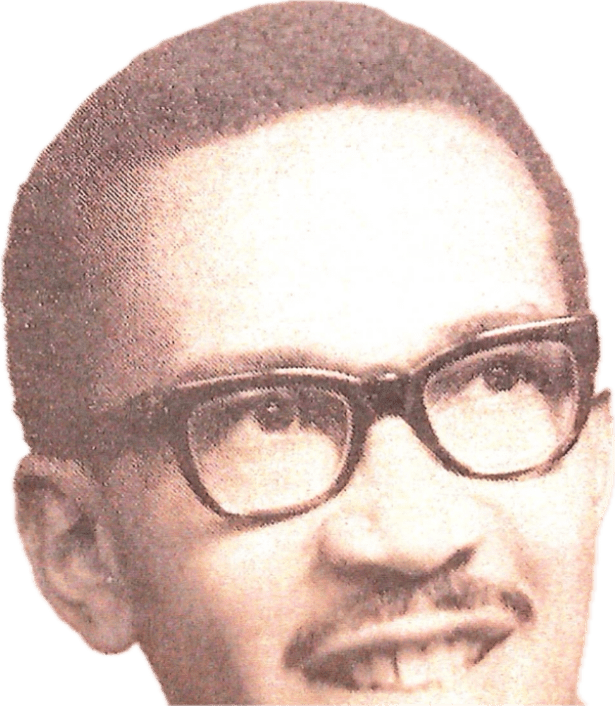
Russell Jackson
Dr. Russell Jackson was the first black superintendent in Arizona . He was an abiding educator and leader to different communities.

Russell Jackson was born February 26, 1934 in Philadelphia, Pennsylvania. A self-described “depression baby,” Jackson grew up aware of social and economic realities that came from years of poverty. As a child, Jackson’s home was also a shop where his father ran a business repairing radios, cameras, and record players. The dining room and kitchen in the home had no heat, although the bedroom did. Food was scarce during these times. At times, his parents could not afford to purchase so much as a loaf of bread, which was about three cents a loaf.
Jackson had four siblings, of whom were each about 14 months apart from one another. His mother was seventeen and his father was nineteen when Jackson was born. His mother rarely kept a job, and spent most of her time as a homemaker. Jackson called World War II a “God-send,” because it gave women and men the chance to earn income.
{6:10 Early Life}
Jackson loved school. He was always one of top students in his class. Growing up he always loved literature and grammar due to the structure of the subjects. He started in an all black school through the third grade and up. Then, Jackson’s father purchased a row house and the family moved into a new community, where the schools were integrated with white and African American students, although the black population was very small. Jackson then attended West Philadelphia High School from1946 to 1949.
After high school graduation, Jackson attended Cheyney State University, a Historically Black College University (HBCU). All of the 300 students and almost all of the faculty were African American. Jackson remembered, “We were taken from childhood into manhood and womanhood in a short period of time”. He felt that he was taken out of the inner city and fell into a new group of intellectuals. He graduated third in his class in 1956.
Shortly after graduating in January of 1956, Jackson became a teacher. But then, he received a draft notice to report for duty. He was able to postpone and finish out the school year. Now a member of the Navy, Jackson moved to Northern Virginia. There he learned to type, and soon he was able to type nineteen words per minute, which permitted him to work in the Navy offices. In 1959 Jackson was accepted to Howard University, and the Navy allowed him to leave a year earlier than planned.
He returned to the Philadelphia public schools, where he became an assistant principal, and then tested for his principal’s license. Jackson passed both the oral and objective exam with over eighty percent the first try, and within thirty days he became the youngest principal in Philadelphia at the age of 29. He was assigned the principalship but was not assigned to a particular school. Instead, the Philadelphia School District looked to Jackson to help integrate their entire school system for the very first time.
From there, Jackson was assigned to a school in Chester, Pennsylvania. At first, he wasn’t convinced to take because there were very few Black leaders in the district. He accepted the job which raised his salary from nine thousand dollars to thirteen thousand dollars. He continued the assistant superintendent job for two and a half years and received a job recruitment to become a superintendent but resisted. After being convinced by citizens in his community he accepted the job offer which was located in East Orange New Jersey. He spent four years working as a superintendent in New Jersey with tenure, meaning a permanent job within this role.
A job came across the desk for the Superintendent of Roosevelt School District in Phoenix, Arizona. He applied for the job. When he was hired, Jackson learned that he had beat out over three hundred and sixty five applicants. He moved to Arizona in 1972 and lived on Thirteenth Place, south of Baseline Road. When he moved there, his house was one of three on a dirt road, surrounded by citrus trees. Taking the job also meant taking a pay cut, because the Superintendent was not allowed to make more than the Governor of Arizona at the time, about thirty thousand dollars. But he wanted the opportunity to serve the South Phoenix community, who needed leaders with a vision. At the time, the Roosevelt school District served four thousand students on double sessions and the schools were segregated, even though it was nearly twenty years after the Brown v. Board decision.
{20:04 Phoenix Arrival}
All of South Phoenix was segregated in the early 1970s, resulting from nearly a century of racist housing and employment restrictions in the Phoenix metro areas. Most African Americans lived between 48th Street and 7th Streets south of the Salt River. African American students primarily attended schools on the east side of RSD, and grades first to fourth ran on double sessions. The first session started at seven thirty until about noon, and then it was time for the next group to start school. By time the children of the second session got home it was often late and dark.
Jackson faced additional limitations when it came to Mexican American students. Many weren’t allowed to enroll unless their family could prove citizenship, or had green card status, but Jackson set about admitting them anyway. At this time, school integration, busing, and neighborhood politics in South Phoenix reflected much of the debates occurring across the country. An RSD court order emphasized integration but federal legislation favored busing, meaning to transport them to schools outside their neighborhoods to provide racial balance. Although he was threatened to be taken to court many times , Jackson sought to avoid busing whenever possible.
{29:39 Related Upbringing}
The segregation within the Roosevelt school district really surprised Jackson, because it was different from what he had experienced on the East Coast. It really appalled him. Coming to Arizona. he believe to had to do what he called his due diligence, such as meeting up with citizens of the community to get a feel of where he was going to be residing. The composition of school district board that hired him consisted of two African-Americans, two white members, and one Hispanic member. The two African-Americans were prominent in the black community. Jackson saw that the Black southside churches were the core, where important business and social activities took place.
{27:32 Reflections on South Phoenix}
Some of Jackson’s proudest memories included pushing for professional development and teachers’ unions, launching a kindergarten program in 1973, and improving reading and math achievement scores from kindergarten to third grade while he served as Superintendent.
Dr. Russel Jackson valued equity, quality, integrity, achievement, service, and humility. These were all of his operating principles that he lived by which has led him to positively change rule, regulations, and habits in so many districts.
{51:00 Impact on Legacy}
Click here for the index to Jackson’s interview
| Narrator | Dr Russel Jackson |
| Birthdate | February 26, 1934 |
| Place of origin | Philadelphia, Pennsylvania |
| Place of residence | Phoenix, Arizona |
| Role | Teacher , Superintendent , Principal |
| Years active in South Phoenix | 1972-Present |
| Recording duration | 1:23:31 |
| Date | 8/26/2024 |
| Location | South Mountain Community College |
| Interviewed by | Faculty Researcher Summer Cherland and students |
| Story written by | Student Researcher X (last name withheld) |

