

*Reverend George Brooks, Sr. passed away in 2007. Students and faculty of the South Phoenix Oral History Project never had the opportunity to interview him. Instead, this biographical story was written by one student who was interested in Brooks’ lasting legacy. She compiled this story from secondary research and by analyzing an interview done with Reverend Brooks’ adult children, Dr. George Brooks, Jr. and Susan Morris-Brooks in 2021.
George and Susan Morris Brooks are the son and daughter of George Benjamin Brooks Sr. Their father was a minister, activist, educator, and guiding light in South Phoenix. In a 2021 interview his children spoke about his involvement within the people of South Phoenix and how he provided support for the minorities that lived there around the church.
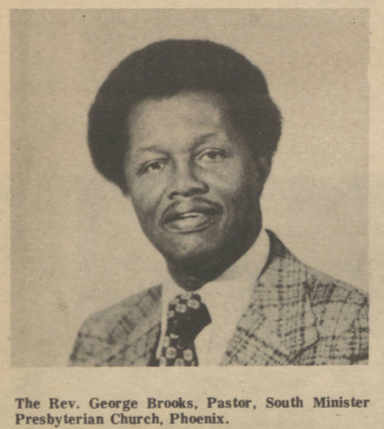
George Brooks Sr. was born on January 18th, 1926 in South Carolina. He later moved to New York City after his father and grandmother’s death while his sister and mother were already settled in New York. He also served in the military during that time.
His son, George Brooks Jr. was born in 1955 in Phoenix Arizona and his daughter Susan was also born in 1963 in Phoenix Arizona. Dr. George Brooks Jr. is also an educator and Susan is an entrepreneur. Both continue to educate others on her experiences and her father’s legacy.
George Brooks Sr. arrived in Phoenix in 1953 when he was approached by Presbyterians who convinced him to come to Phoenix to start the first African American Presbyterian Church. While serving as a minister in the church he was also the President of the NAACP from 1964 to 1972 and started informing and creating campaigns for the civil rights movement for African Americans. He also helped create a HeadStart program/school for young children to help with public education for the children around the Phoenix area.
[ Future clips : 4:31, What brought family to Arizona, 9:57, Susan’s p.o.v of growing up, 12:27, George’s p.o.v of growing up, 16:17, HeadStart School ]
At the time, the Civil Rights Movement was in full force across the country. Ministers like Brooks faced extreme risks when they campaigned and protested, because their jobs could be at stake. Brooks nonetheless dedicated his career to educating others on the need for social justice, civil rights, and Black freedom.
Future Clip: [ Insert clip: 18:42 , Susan speaks of civil rights movement , 29:04, Susan remembers racism during school ].
Reverend Brooks was a civil rights champion and a passionate advocate for South Phoenix African Americans. He served and helped others in church spreading wisdom and kindness to others , specifically African Americans since it was rough during that time. He saw how poorly educated the children were around the Phoenix area and wanted to contribute and help so he reached out to others to have funds to create programs like HeadStart so that children weren’t behind on basics ( reading & writing ). He used his contacts with national activists like Dr. Martin King, Jr. and Medgar Evers to bring change to South Pheonix. In doing so, Brooks, Sr. became one of the most significant civil rights leaders in Arizona history.
Future Clips: [ Insert Clips: 19:12, George Brooks Sr. meeting Dr. King, 39:33, Black ministers didn’t march ].
George Brooks Sr. left a legacy of being a great father, minister, activist, and educator. His two children are among the many who have helped carry that legacy into the 21st century.
| Narrator | Dr. George Brooks, Jr. and Susan Morris Brooks |
| Birthdate | January 18, 1926 – September 26, 2007 |
| Place of Origin | Edisto Island, Charleston Co., SC, USA |
| Place of Residence | South Phoenix, AZ |
| Role | Founding pastor of Southminster Presbyterian Church, activist, legislator |
| Years active in South Phoenix | 1951-2007 |
| Interview Date | February 25, 2021 |
| Location | Zoom |
| Duration | 1:09:29 |
| Interviewed by | Faculty Researcher: Summer Cherland, PhD |
| Story Written by | Student Researcher: Sophia Monclova and Faculty Researcher: Dr. Summer Cherland |
 South Phoenix Oral History Project